2026-08-11
Garage Door Opener Remote Thinking for Remote Team Collaboration
A garage door opener remote looks like a simple object until it fails. Then everyone suddenly cares about signal range, pairing, access, state, obstruction sensors, fallback keys, and who is allowed to open what.
Remote teams hit the same problem with collaborative screen sharing. A designer shares a prototype, a developer asks for control, someone else takes over, the wrong window is active, and nobody is fully sure who is driving. The UI looked simple. The workflow was not.
Teams think the problem is better screen sharing. The real problem is controlled access to a shared operating surface.
That changes the conversation. A garage door opener remote is not useful because it has buttons. It is useful because it turns intent into a constrained, observable, reversible action. The practical question for remote teams in 2026 is not whether people can see the same screen. It is whether the team can safely share control without creating confusion, security risk, or operational drag.
Table of contents
- Why a garage door opener remote is the right mental model
- Translate the garage door opener remote pattern into remote teamwork
- Design the control architecture before the meeting
- Build safer handoffs and approvals
- Make latency, failure, and recovery first-class
- Garage door opener remote security lessons for collaborative screen sharing
- What works and what fails in implementation
- Metrics that tell you whether collaboration is improving
- Product fit: where PairUX belongs in this workflow
- Implementation checklist for 2026
Why a garage door opener remote is the right mental model
A useful way to think about it is this: a remote team session is a garage door in software form. There is an asset behind the door. There is a person asking for control. There is a mechanism that must respond predictably. There is feedback that tells everyone what happened.
The analogy is not cute. It is operational. A garage door opener remote solves a control problem with a narrow interface, clear authorization, and immediate feedback. Remote teams need the same discipline when they share screens, pass control, debug code, review UI states, or operate production-like environments together.
For a deeper version of this framing, we previously covered how garage door opener remote lessons apply to collaborative control across permissions, handoffs, and support workflows.
Related reading from our network: teams shipping physical or software products face a similar control-system problem when they turn a product promise into an operating workflow, as covered in tops products shipping systems for 2026.
The control surface is intentionally small
A garage door remote usually gives you one or two meaningful actions. Open. Close. Maybe light. That limitation is the point. The device does not expose every motor parameter, sensor setting, or access rule to the driver. It exposes the smallest safe surface required to complete the job.
The mistake teams make is exposing collaboration as an all-or-nothing control event. Someone is either watching passively or controlling the whole machine. That is convenient for a demo, but risky for real work.
In a remote design review, full control may be fine. In a production incident, it may be reckless. In a pair programming session, it depends on the repo, branch, credentials, and local environment. The control surface should match the risk of the task.
Practical rule: do not grant control because someone asked nicely. Grant the minimum control needed for the next action.
The operation is high trust
A garage door opener remote operates something physical. If it misfires, the consequence is not just annoyance. It can expose property, damage equipment, or create safety issues. That is why pairing, range, rolling codes, sensors, and manual overrides matter.
Remote control in software has its own version of this risk. The person controlling a screen might access customer data, change an environment variable, delete a file, approve a payment, or expose secrets during a screen share.
That does not mean teams should avoid remote control. It means they should treat it like a high-trust operation. The session needs ownership, boundaries, and recovery paths.
Translate the garage door opener remote pattern into remote teamwork
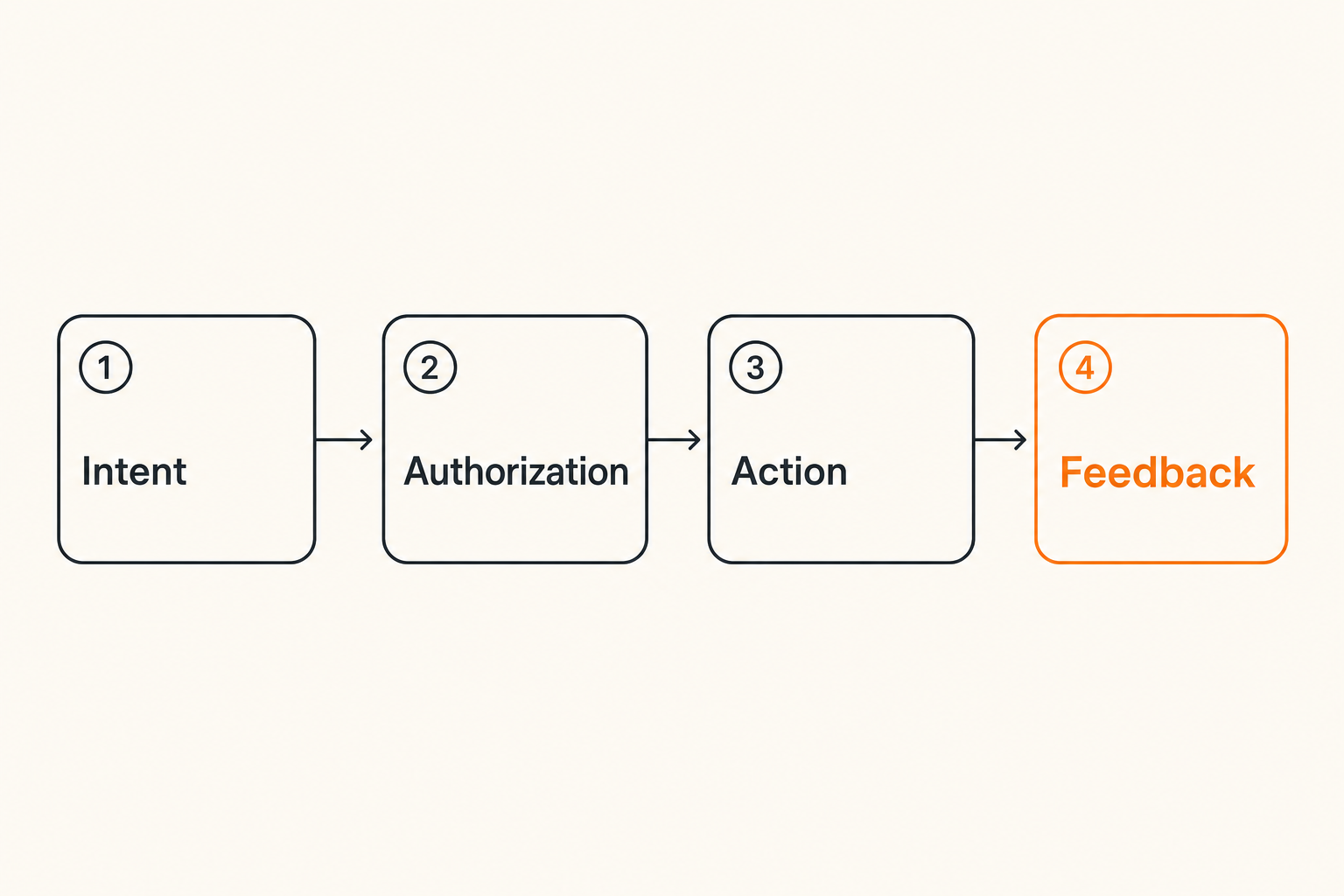
A garage door opener remote is useful because it chains four things together: intent, authorization, action, and feedback. Remote teams need to build that same chain into collaboration sessions.
If any link is missing, the workflow becomes informal. Informal control works for tiny teams until the team grows, hires contractors, supports customers, or handles sensitive work. Then the lack of structure becomes expensive.
Intent, authorization, action, and feedback
Here is the pattern in plain terms:
- Intent: someone signals what they want to do.
- Authorization: the system or owner decides whether they can do it.
- Action: control is granted and the person operates the shared surface.
- Feedback: everyone can see what changed and who is in control.
This is the minimum collaboration loop. It is also where many remote tools stop short. They make the action easy but leave intent and feedback to voice chat.
That works until two people speak at once, someone joins late, or the active driver forgets they still have control. What breaks in practice is not the pixels. It is the shared state.
Why remote control is not just screen sharing
Screen sharing is observation. Remote control is operation. Those are different risk classes.
When someone watches a screen, they can misunderstand what they see. When someone controls a screen, they can change the state of the work. That can be excellent for debugging and collaboration, but it needs stronger design.
A simple comparison helps:
| Collaboration mode | Primary value | Main risk | Required control design |
|---|---|---|---|
| Screen sharing | Shared visibility | Misread context | Clear narration and focus |
| Cursor sharing | Joint attention | Visual noise | Cursor identity and presence |
| Remote control | Direct operation | Wrong action by wrong person | Permission, handoff, revoke |
| Multi-person control | Parallel collaboration | Control collision | Roles, locks, and state rules |
The practical question is not whether remote control is powerful. It is whether the session design prevents power from becoming ambiguity.
Design the control architecture before the meeting
Most collaboration problems are decided before the call starts. If a team enters a session with unclear roles, unclear files, unclear permissions, and unclear goals, no remote control tool can fully compensate.
A garage door opener remote does not decide who owns the house. It assumes the access model already exists. Remote collaboration tools should be used the same way. The session should inherit a clear operating model from the team.
Roles and permissions need names
Teams should name the roles they actually use. Not generic titles like admin and user. Practical session roles.
Common roles include:
- Host: owns the shared machine or workspace.
- Driver: currently has input control.
- Navigator: guides the driver and watches for mistakes.
- Observer: watches but does not control.
- Approver: confirms risky actions before execution.
- Recorder: captures decisions, bugs, and follow-ups.
These names reduce friction because they let people request a specific state. I need driver for two minutes is clearer than can I control your screen.
Related reading from our network: coverage and ownership issues show up outside software too, and the same role clarity appears in staff scheduling software workflow design.
Practical rule: if your team cannot name who is driving, who is approving, and who can revoke control, the session is not ready for risky work.
State, focus, and visible ownership
The shared screen needs visible state. Who is driving? What window is active? Is control currently local or remote? Is the session recording? Is the team in read-only, co-navigation, or direct control mode?
Without visible ownership, people build their own mental models. That is where mistakes happen. A developer assumes the designer is still driving. The designer assumes the developer has stopped. The host starts typing locally while the remote controller is also moving the cursor.
Good collaboration systems make ownership obvious. Bad systems bury it in a toolbar or rely on memory.
A simple session state model can look like this:
- Idle: nobody has remote control.
- Requested: a participant has asked for control.
- Granted: a named participant has control.
- Suspended: control is paused but not ended.
- Revoked: control was removed by host or policy.
- Ended: the session has closed.
The important point is not the exact labels. The important point is that the team can reason about the state.
Build safer handoffs and approvals
Remote collaboration breaks down at the handoff. One person is explaining, another is acting, a third is asking questions, and the state of control changes faster than the conversation.
Garage door systems handle handoff by being boring. The remote sends a signal. The opener validates it. The door moves. The light or motor confirms the action. Nobody debates whether the signal maybe counted.
Remote teams need handoffs that are just as explicit.
The handoff workflow
A workable handoff sequence looks like this:
- Host states the goal: please update the component spacing in this file.
- Driver requests control for that goal.
- Host grants control and names the driver.
- Driver repeats the intended action before changing state.
- Driver performs the action.
- Host or navigator confirms the result.
- Driver releases control or host revokes it.
- Recorder captures any follow-up.
This may sound heavy. In practice, it is fast. The overhead is a few seconds. The cost of ambiguity can be much higher.
For low-risk sessions, the sequence can be lightweight. For sensitive sessions, keep the full version. The mistake teams make is using the same control style for a Figma critique, a local dev environment, a customer support session, and a production console.
What breaks when control is ambiguous
Ambiguous control creates predictable failure modes:
- Double input: local and remote users act at the same time.
- Silent takeover: someone gains control without everyone noticing.
- Lost context: the driver acts without understanding the prior state.
- Approval drift: a risky action happens before the approver weighs in.
- Session residue: control remains active after the task ends.
- Support confusion: nobody can reconstruct who changed what.
These are not edge cases. They are normal outcomes when teams treat control as a button instead of a workflow.
Practical rule: a control handoff is not complete until the previous driver knows they are no longer driving.
Make latency, failure, and recovery first-class
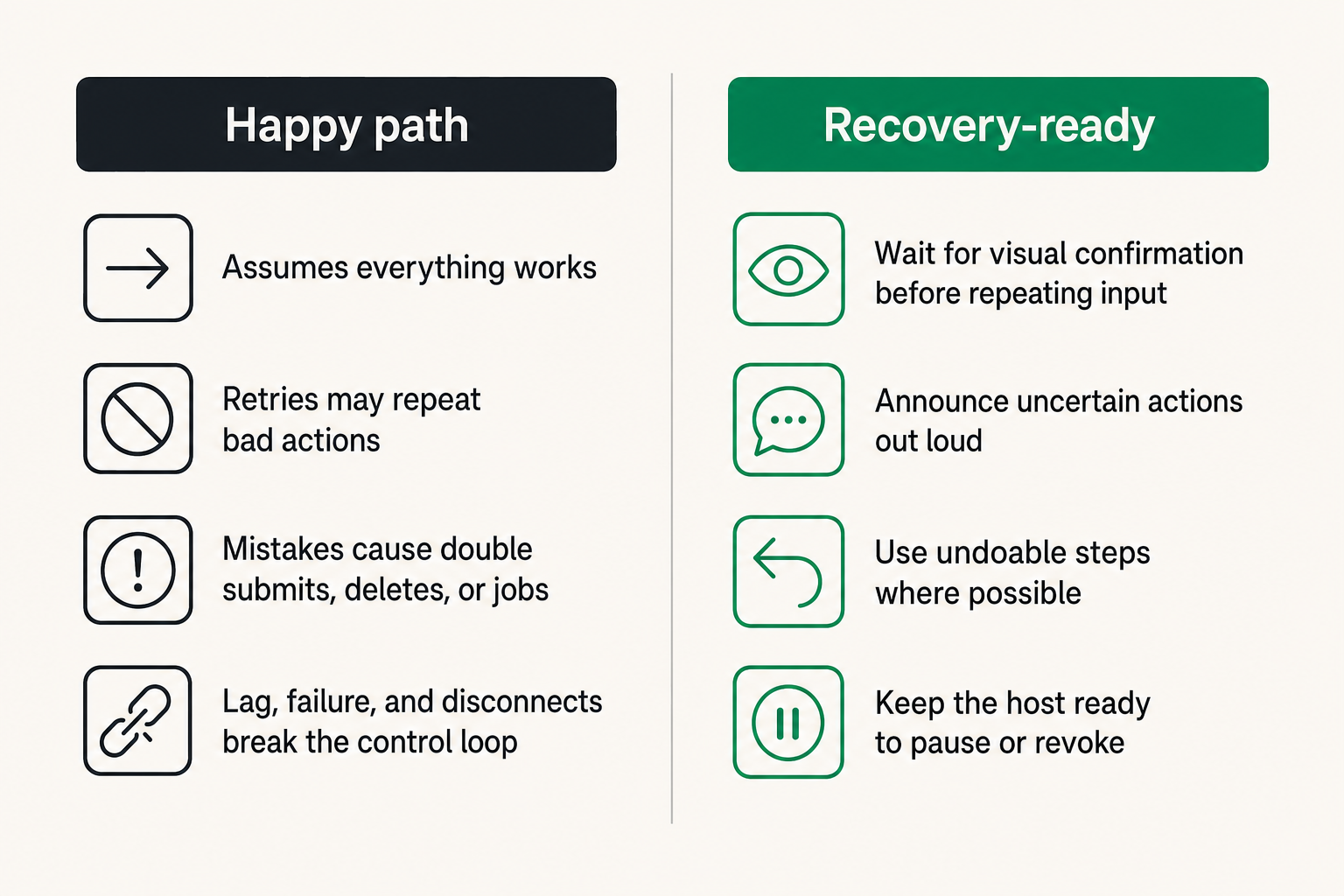
Every garage door opener remote has failure modes. The battery dies. The door stops halfway. The sensor detects an obstruction. The remote loses pairing. The motor works but the door does not move.
Remote collaboration has the same shape. Latency, packet loss, frozen frames, stale screens, input lag, crashed apps, permission prompts, and audio delay all distort the control loop.
The mistake teams make is designing for the happy path only. Production collaboration needs recovery design.
Retry without repeating bad actions
Retries are dangerous when the action is not idempotent. Pressing a garage door remote twice may open then close the door. Clicking a destructive UI twice may submit twice, delete twice, or trigger two jobs.
Remote control tools and team workflows need to account for this. When a remote click appears not to register, the driver should not blindly click again. The system should provide enough feedback to distinguish lag from failure.
Good retry behavior looks like:
- Wait for visual confirmation before repeating input.
- Announce uncertain actions out loud.
- Avoid double-clicking high-impact controls.
- Use undoable steps where possible.
- Prefer staging environments for exploratory control.
- Keep the host ready to pause or revoke.
For software teams, this is especially important around deploy buttons, database consoles, billing tools, admin dashboards, and customer records.
Design for disconnects and stale context
A stale screen is worse than no screen because it looks valid. Someone may be acting on a view that is no longer current. The remote driver sees one state, the host sees another, and both assume the other person is aligned.
Collaboration systems should make disconnects obvious. They should also fail closed. If the session connection becomes unstable, remote control should pause or require confirmation before continuing.
A practical recovery policy:
- If video freezes, stop input.
- If audio drops, pause control.
- If the active app changes unexpectedly, re-confirm intent.
- If the host leaves, revoke remote control.
- If the driver disconnects, return control to the host.
This is where remote work maturity shows up. Amateur teams rely on vibes. Effective teams write down the recovery path.
Garage door opener remote security lessons for collaborative screen sharing
A garage door opener remote is a security device disguised as a convenience device. It grants access. It needs pairing. It can be lost. It can be copied badly. It can be trusted too much.
Collaborative screen sharing has the same risk profile. If a tool allows remote control, it is part of your access model. Treating it as a meeting feature is how teams create gaps between identity, device access, and operational control.
Least privilege for remote sessions
Least privilege in remote collaboration is simple: give less control, for less time, to fewer surfaces.
That means:
- Share one app instead of the whole screen when possible.
- Use a test account instead of a privileged account.
- Close unrelated windows before the session.
- Remove secrets from terminals and config files.
- Grant control only after the task is clear.
- Revoke control when the task is complete.
The same principle applies to recording and notes. Do not record sensitive data just because the tool makes recording easy. Convenience is not a security policy.
Teams looking for setup guidance should keep operational details close to the tool configuration; PairUX maintains practical usage and security information in the PairUX docs.
Audit trails without theater
Audit logs are useful only if they answer operational questions. Who had control? When was it granted? Who revoked it? What session was active? What was the stated purpose?
Many teams collect logs they never review. That is theater. The goal is not to create a pile of events. The goal is to shorten investigation time when something goes wrong.
A useful audit trail for collaborative control should include:
- Session owner.
- Participants.
- Control request time.
- Grant and revoke events.
- Active driver identity.
- Session duration.
- Optional task label or ticket reference.
You do not need surveillance-heavy behavior to get value. You need enough context to reconstruct the control chain.
What works and what fails in implementation
Most teams do not need a giant policy document. They need a few constraints that match how work actually happens. The best systems are simple enough to use under pressure and strict enough to prevent obvious mistakes.
This is where the garage door opener remote model helps again. It does not ask the user to become a mechanic. It gives them a clear interface and handles the safety constraints behind the scenes.
What works
What works is boring and repeatable:
- Use named session roles.
- Make driver identity visible.
- Require explicit control requests.
- Keep host revoke available at all times.
- Pause control on connection instability.
- Separate low-risk and high-risk sessions.
- Define what must never be done over remote control.
- Review incidents without blaming the tool by default.
Teams should also decide which work types are allowed in collaborative control sessions. For example:
| Work type | Remote control allowed | Extra condition |
|---|---|---|
| UI review | Yes | Host can revoke anytime |
| Pair programming | Yes | Use non-production credentials |
| Customer support | Sometimes | Customer consent and scoped access |
| Production deploy | Rarely | Approver present and rollback ready |
| Billing admin | Rarely | Strong identity and audit trail |
| Secret rotation | No by default | Use documented internal process |
This table will vary by company. The important part is having the conversation before the incident.
What fails
What fails is pretending that collaboration is self-governing.
Common failed patterns:
- Permanent remote control permissions.
- Whole-screen sharing by default.
- No visible driver state.
- No revoke habit.
- No distinction between demo and operations.
- No session notes for important decisions.
- No policy for contractors or guests.
- No recovery plan when the host disconnects.
The result is not always a dramatic breach. More often, it is slow operational decay. People hesitate to collaborate because sessions feel risky. Senior people become bottlenecks because they do not trust handoffs. Support gets messy because nobody knows who did what.
That changes the conversation from tool adoption to workflow design.
Metrics that tell you whether collaboration is improving
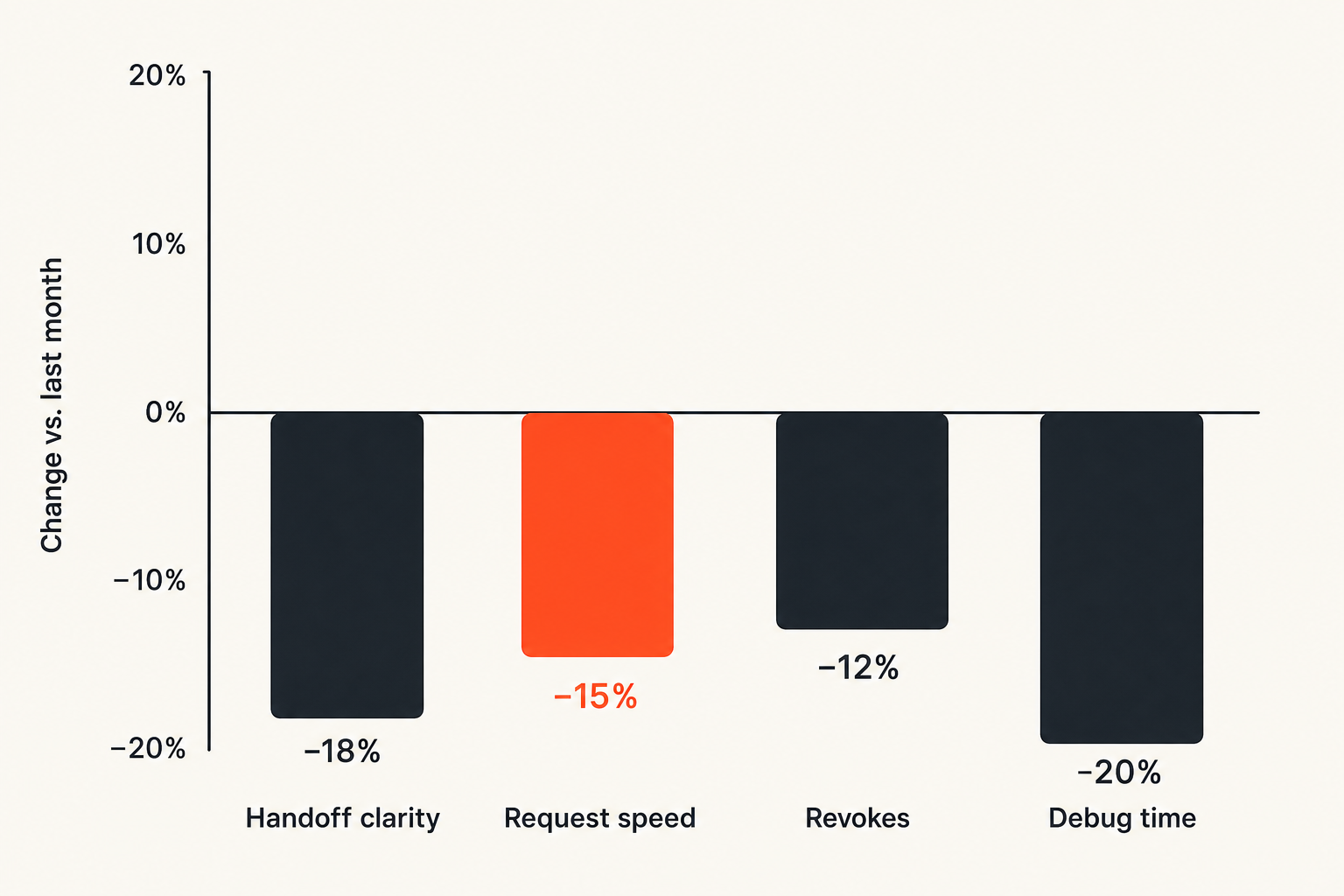
If you improve remote collaboration, you should see it in operations. Not vanity metrics. Real signals that show less confusion and faster shared work.
The goal is not to measure every cursor movement. The goal is to understand whether collaborative control is reducing friction or introducing risk.
Related reading from our network: content teams face a similar measurement problem when automation expands but human review still matters, as described in AI publishing software workflow architecture.
Operational signals to watch
Useful signals include:
- Time from control request to grant.
- Number of control handoffs per session.
- Number of accidental takeovers or collisions.
- Frequency of host revokes.
- Sessions ended with unresolved ownership.
- Incidents involving shared control.
- Time to resolve design or debugging tasks.
- Participant confidence after sessions.
Do not over-instrument this. Many teams can start with lightweight notes and a monthly review. The first goal is visibility, not dashboards.
A practical dashboard can be as simple as:
| Signal | Healthy direction | Why it matters |
|---|---|---|
| Control request time | Down | Less waiting and friction |
| Ambiguous handoffs | Down | Clearer ownership |
| Emergency revokes | Down | Better fit between risk and control |
| Debug session duration | Down | Faster shared diagnosis |
| Follow-up clarification | Down | Better context capture |
Metrics should support judgment, not replace it.
A simple review cadence
Use a short monthly review:
- Pick three collaboration sessions that mattered.
- Ask where control handoff was smooth.
- Ask where the team lost context.
- Identify one permission or workflow change.
- Update the team playbook.
- Remove one unnecessary rule if it is not helping.
The last step matters. Teams often add rules after a scare and never remove them. The result is policy clutter. A good collaboration workflow should get sharper, not heavier.
Product fit: where PairUX belongs in this workflow
PairUX fits the part of the workflow where shared visibility and shared control need to become deliberate. The point is not to make every meeting more interactive. The point is to make the right sessions safer and faster.
For remote teams, product designers, software developers, and startup operators, the core need is practical: see the same thing, hand off control, collaborate without losing state, and keep the session understandable.
Practical feature mapping
PairUX is built around collaborative screen sharing with remote control, so the relevant product questions are operational:
- Can the team see who is participating?
- Can control be handed off cleanly?
- Can multiple people collaborate without losing focus?
- Does it work across the operating systems the team actually uses?
- Can the workflow support design review, debugging, onboarding, and support?
You can explore the product capabilities in the PairUX features overview, including real-time screen sharing, remote control, multi-cursor collaboration, and cross-platform support.
The garage door opener remote mental model is useful here because it keeps the team honest. Features matter only when they support a safer control loop. A flashy interface that hides ownership is worse than a plain interface that makes control obvious.
Rollout advice for teams
Do not roll out collaborative remote control by telling everyone to use it more. That is not an implementation plan.
Start with two or three workflows:
- Pair debugging for local development.
- Design critique with direct manipulation.
- Internal support for onboarding and tooling issues.
Then define the boundaries:
- Which workflows are allowed.
- Which are restricted.
- Who can host.
- Who can request control.
- What must be closed before sharing.
- When to stop and switch to an async process.
After that, train the team on the handoff language. The words matter. Requesting control, granting control, pausing control, and revoking control should become normal phrases.
Implementation checklist for 2026
By 2026, remote teams have had enough time to know that working online is not the same as working well online. The basics are solved. The messy part is collaborative operation: shared screens, shared input, shared context, and shared responsibility.
The garage door opener remote gives teams a simple test. If the control action is powerful, the workflow around it should be explicit.
The 10-step rollout sequence
Use this implementation sequence if your team is formalizing remote control and collaborative screen sharing:
- List the workflows where remote control creates real leverage.
- Classify each workflow as low, medium, or high risk.
- Define named session roles for each workflow.
- Decide which apps or environments can be shared.
- Create a standard control request and grant phrase.
- Require visible driver ownership during sessions.
- Set recovery rules for lag, disconnects, and frozen screens.
- Define what events should be logged or noted.
- Review three real sessions after the first month.
- Tighten the workflow based on what actually broke.
This sequence is deliberately practical. It does not require a committee. It requires operators to look at how work happens and remove ambiguity.
Practical rule: if a collaboration rule does not change behavior during a real session, remove it or rewrite it.
Closing the loop
The point of the garage door opener remote analogy is not that teams need fewer buttons. It is that teams need a reliable control loop.
Intent should be clear. Authorization should be deliberate. Action should be scoped. Feedback should be visible. Recovery should be known before failure happens.
When remote teams get this right, screen sharing stops being a passive meeting habit and becomes an operating surface. Designers can hand over prototypes without chaos. Developers can debug together without fighting for the cursor. Startup operators can support teammates without turning every session into an access risk.
A garage door opener remote is small, but the architecture behind it is serious. Treat collaborative remote control the same way.
Try pairux.com
PairUX is for remote teams that need fast, practical collaborative screen sharing, remote control, and online teamwork without turning control into confusion. Try pairux.com.